LOCAL SEO RESOURCES
How Long Does It Take to Rank on Google Maps in 2026?
Quick answerOn Google Maps, established profiles often move 4 to 8 weeks after real fixes, while new ones usually take 3 to 6 months or longer, and service-area businesses can be slower away from their address. These are ranges, not guarantees. Run a GeoGrid baseline, then rescan at weeks 4, 8, and 12.
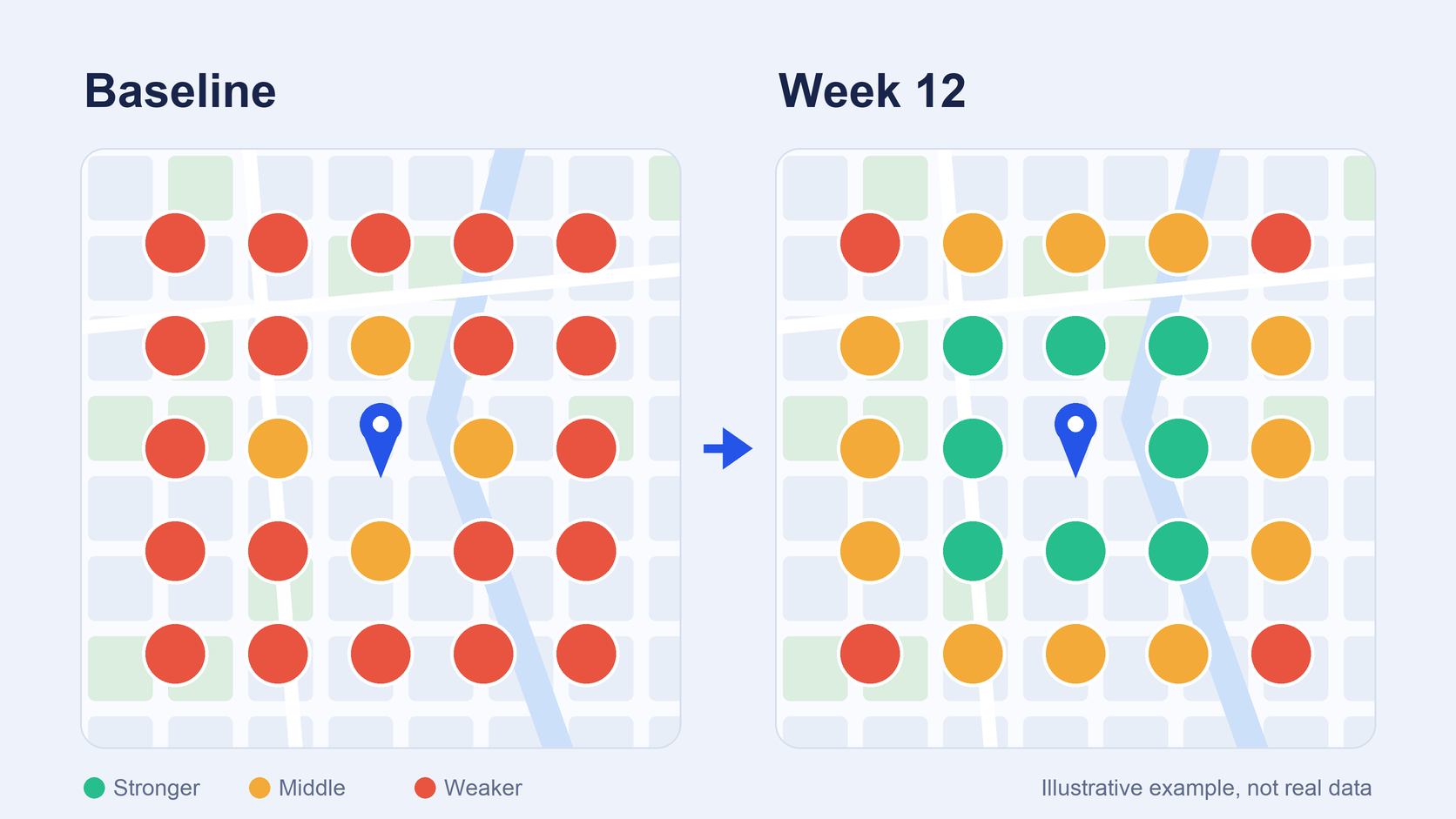
Most local SEO pitches come with a number attached, and it’s usually 30 or 90 days. We’d rather give you a range and a way to check it yourself. LocalPanda is a local marketing AI agent for local businesses, and rank tracking is part of what we sell, so we have a stake in this question. Keep that in mind as you read.
The ranges in this post are our planning estimates. They aren’t Google figures, and they aren’t from a published study, because Google doesn’t publish a ranking timeline and we know of no independent study that does.
Why “30 days” claims fail
A 30-day Google Maps ranking promise fails because Google publishes no timeline and nobody controls the result. Google’s local ranking help page says local results are “mainly based on relevance, distance, and popularity” and that “there’s no way to request or pay for a better local ranking.” Its guide to hiring an SEO is blunter: “No one can guarantee a #1 ranking on Google.”
When a 30-day win does show up in a report, check what was measured. It’s usually one of these:
- An easy keyword. A long phrase few businesses compete for, or your own business name.
- One location. A single check taken close to your address, where you were already likely to rank.
- Normal wobble. Google Maps results can shift during a day, so one better scan can happen with nothing changed.
New profiles also lose time before any ranking work counts. Google says verification reviews take up to 5 business days, and most postcard codes arrive within 14 days. On a postcard, that’s nearly half of a 30-day promise gone.
Ask anyone who quotes you 30 days three questions: which keyword, measured from where, and compared with what baseline?
New profile timeline
A new Google Business Profile usually takes 3 to 6 months to show up for non-branded searches, and 6 to 12 months in a competitive market. The order of events is more predictable than the dates:
- Verification. The profile can’t do much until Google has confirmed it.
- Name searches. You start appearing when people search your exact business name. That tells you the listing is live. It doesn’t mean you rank.
- Nearby, low-competition terms. Searches close to your address with few rivals tend to move first.
- Broader terms across the area. This is the slow part. Popularity builds through reviews, links, and being known locally, and that takes real customers and real months.
| Situation | First movement | Clearer gains |
|---|---|---|
| Established profile, storefront | 4 to 8 weeks after real fixes | 2 to 4 months |
| Established profile, service-area | 4 to 8 weeks, near your base | 3 to 6 months |
| New profile, storefront | Name searches soon after verification | 3 to 6 months, or 6 to 12 in a competitive market |
| New profile, service-area | Name searches soon after verification | 4 to 9 months, or 6 to 12+ in a competitive market |
Where you land in a range depends on who you’re up against. A new dental office in a Phoenix suburb, competing with practices that have a decade of reviews, should plan for the long end. A mobile window cleaner in a small Ohio town with two rivals may land at the short end.
Established profile after fixes
An established Google Business Profile often shows first movement 4 to 8 weeks after real fixes, and clearer gains in 2 to 4 months. It moves sooner than a new profile because the reviews, history, and links are already there. Often something was just holding them back.
“Real fixes” means changes to what Google can match you on: a wrong primary category, missing services, wrong hours, or a website that disagrees with the profile on your name, address, or phone. In our view a corrected primary category is worth more than a month of new photos. Photos still help customers. They just don’t repair a bad match.
Not everyone agrees with our range. Merchynt, a competitor of ours, says it takes 4 to 6 months for most businesses to start ranking higher, and that small improvements may come in the first 90 days. That figure comes from its own customer data, with no published method, and it’s aimed at hard-to-rank keywords. Our 4 to 8 weeks is about first movement near the business. If your keyword is competitive, their number is the safer one to plan around.
One thing to avoid while you’re measuring: the “Temporarily closed” label. Google says temporarily closed businesses “can rank after open businesses” on broad queries. Darren Shaw of Whitespark published a one-business test of this in 2024: rankings dipped when the label went on and came back when it came off five days later. If you’re closed for 7 days or less, Google says to use Special hours instead.
Service-area vs storefront
Service-area businesses start on the same clock as storefronts, but ranking across a whole territory usually takes longer because distance still counts. A storefront mostly needs to win the streets around the shop. A plumber in Tulsa who also serves Broken Arrow and Owasso wants to rank in towns the business isn’t in.
| Question | Storefront | Service-area business |
|---|---|---|
| What the customer wants | A place they can drive to | Someone who comes to them |
| Where a grid usually moves first | The streets around the shop | The streets around your base |
| A fair goal at week 12 | A stronger ring around the shop | A stronger home area, with far towns still behind |
| The common mistake | Judging the whole map from the shop parking lot | Adding more service areas and waiting for them to work |
Listing more service areas doesn’t solve this. Whitespark added two ZIP codes to one profile in 2024 and saw no ranking change in either, then concluded that adding service areas “still has no impact on local rankings.” That was a single profile over about three weeks, and Whitespark notes Google could change this, but it matches the grids we’d expect to see: strongest near the base, fading with distance.
So judge a service-area business by zone. Split your grid into near, middle, and far, and expect the far zone to trail for a long time. It may never match the near zone.
What to check at weeks 4, 8, and 12
Run a GeoGrid baseline before you change anything, then rescan at weeks 4, 8, and 12 with the same keyword, center point, and grid. A GeoGrid scan checks one keyword from a grid of points around your business, so you see where you rank street by street, not from one spot.
Pick 3 to 5 keywords a customer would really type, such as “emergency plumber” or “roof repair,” and skip your business name. The GeoGrid Rank Checker gives you a 3x3 view of one keyword. To repeat scans over time, start with a baseline ranking check in the Local Rank Tracker. Before you read too much into any scan, see how LocalPanda tracks rankings and what a grid can’t measure.
- Week 4: are the basics done? Rescan and compare with the baseline, but don’t expect much. Use this checkpoint to confirm categories, services, photos, hours, and review replies are finished. Treat a one-position change at a single point as noise.
- Week 8: is there a pattern? Look for change that holds across several points. If the same neighborhoods stay weak, check who ranks there. Then add service-area content and steady posts aimed at those places, and keep asking every customer for an honest review.
- Week 12: what do three scans say? Put all three side by side. A scan shows that something moved, not why, so keep a dated log of your changes and match them up. Then decide whether to keep going, change keywords, or get help.
Check the business side at the same time. A grid measures visibility, not calls or revenue, so compare your Google Business Profile performance data and booking records too. A roofer whose grid turns greener while calls stay flat has probably picked the wrong keywords.
If nobody on your team has time for this, Panda Managed is our team plus AI agents doing the work each week.
Listing problem vs competition problem
A grid that stays flat after 12 weeks usually points to a listing problem or a competition problem, and they need different fixes. A listing problem is something wrong with your profile, and you can often fix it in days. A competition problem means rivals have earned more than you have, and closing that gap takes months.
| What you see | Likely problem | What to do next |
|---|---|---|
| You don’t appear when you search your own business name | Listing | Confirm the profile is verified and not suspended or restricted |
| You rank poorly even at grid points beside your address | Listing | Check the primary category, your services, and whether the keyword matches what you actually sell |
| The whole grid drops right after you edit the profile | Listing | Review the recent edits and the profile’s status before changing anything else |
| You rank well near the address and fade with distance | Normal distance effect | Keep going. Work on the middle of the map first, not the far edge |
| The same two or three competitors hold most grid points | Competition | Compare their categories, review volume, and service pages with yours, then plan for months |
| A competitor beats you only around its own address | Normal distance effect | Leave it alone and spend your time elsewhere |
Check for listing problems first, because they’re cheaper to fix and they make every other effort worth less. The free local SEO audit is a one-time check of your Google Business Profile, map rank against competitors, reviews, website, and AI search visibility, and it lists your top 5 fixes. If the listing comes back clean and the same competitors still hold the map, you’re looking at a longer job, and the ranges above are the ones to plan around.
Frequently asked questions
How long does local SEO take?
Local SEO usually takes 4 to 8 weeks to show first movement on an established Google Business Profile, and 3 to 6 months on a new one. Competitive markets can take 6 to 12 months. These are planning ranges, not Google figures. Google publishes no timeline, and no one can guarantee a ranking.
How soon will a GeoGrid show movement?
A GeoGrid scan often shows first movement by the week 4 or week 8 rescan on an established profile, starting with the points closest to the business. New profiles usually take longer. One scan proves little, because Google Maps results can shift during a day, so look for a change that holds across several points and repeated scans of the same grid.
Does temporarily closing a profile reset the clock?
Temporarily closing a Google Business Profile has no known reset effect, but it can hurt rankings while the label is up. Google says temporarily closed businesses can rank after open businesses on broad queries. In a one-business test, Whitespark saw rankings dip and then recover after reopening five days later. We found no public data on long closures. For 7 days or less, use Special hours, and never delete and recreate the profile.
Can LocalPanda’s team do this work for me?
Yes. With Panda Managed, our team and our AI agents do your Google Business Profile, website, content, citation, and review work every week, following a 90-day plan agreed on your kickoff call. A dedicated account manager reports what moved every month.
How much does Panda Managed cost?
Panda Managed costs $199/mo for 1 location, $249/mo for 2, up to $629/mo for 10 ($50/mo each for locations 2–9, $30/mo for the 10th), in USD, billed monthly with no contract. Panda AI is included, so you can watch the work and your rankings live.
What is the difference between Panda AI and Panda Managed?
Both run on AI agents; the difference is who works with them. Panda AI is you + an AI agent: the agent finds what to fix each week and drafts the work, and you approve and publish it, from $29/mo. Panda Managed is our team + AI agents: we run the agents, review the work, and ship it for you, from $199/mo.
Rather have our team do it? Our team + AI agents, from $199/mo →