What is AI search visibility for local businesses?
AI search visibility (sometimes called GEO, or generative engine optimization) is whether and how a local business gets mentioned when someone asks an AI assistant like ChatGPT, Gemini, or Google AI Mode a question that should surface it — "who's the best plumber near me," for example. It's distinct from traditional rankings because the output is a written or spoken answer, not a list of blue links.
How is AI search visibility different from traditional local SEO?
Traditional local SEO optimizes for Google Maps and organic rankings, driven heavily by proximity, relevance, and prominence signals Google has published and studied for years. AI search visibility depends on what the underlying model has learned about a business from its training data and the live sources it retrieves — reviews, directories, your own website, and how consistently your business is described across the web. Many of the same fundamentals (accurate business info, strong reviews, clear service pages) matter for both, but the mechanics of how an AI assistant selects and phrases a recommendation are different and less transparent.
Do ChatGPT, Gemini, and Google AI Mode all work the same way?
No. They pull from different data sources, update on different schedules, and can give different answers to the same prompt. A business that's mentioned by one may be missing from another. Tracking all three separately, with the same set of realistic prompts, is the only reliable way to know where you actually stand.
Can I guarantee my business gets recommended by AI assistants?
No. No tool, including LocalPanda, can guarantee a specific AI-generated answer, since responses are non-deterministic and can change between runs, prompts, and model versions. What you can do is improve the underlying evidence — accurate business information, reviews, content, and directory presence — that makes a recommendation more likely.
What evidence do AI assistants seem to rely on for local recommendations?
Based on observed patterns, not confirmed model internals: consistent business information across your website and directories, review volume and recency, specific service or practice-area content, and third-party corroboration (directories, local publications, industry associations) all appear to play a role. Treat this as informed observation, not a documented ranking algorithm.
How does LocalPanda track AI search visibility?
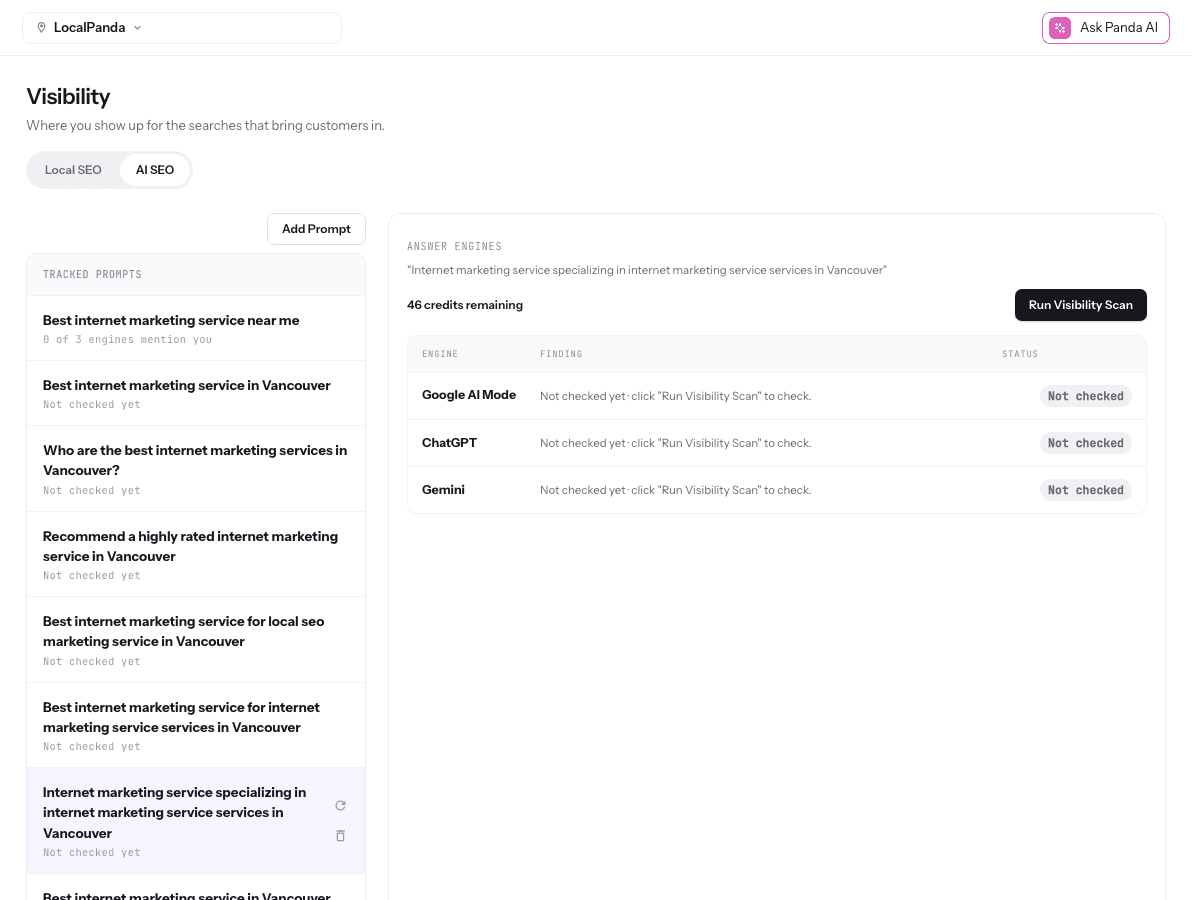
LocalPanda tests a defined set of prompts against ChatGPT, Gemini, and Google AI Mode on a recurring basis and records whether and how your business is mentioned, alongside your Google Maps rankings, so you can see both in one place instead of two disconnected tools.
Is AI search visibility worth tracking for a small local business?
It's increasingly worth checking, even if it's not yet the majority of your traffic. Buyer behavior is shifting toward asking assistants directly for recommendations, and the businesses that show up early tend to have already fixed the basics (accurate info, strong reviews, clear content) that also help traditional local SEO.