An AI marketing agent for law firms is software that continuously checks Google Maps rankings, AI search visibility, your Google Business Profile, and reviews for a law firm, then drafts and — with your approval — publishes the fixes and content that keep you visible every week. Illustrated throughout using Harbor Personal Injury Law, Seattle, WA — a fictional business used throughout this playbook to make every recommendation concrete. Names, numbers, and competitor details below are illustrative examples, not real data.
Darren describes a Connecticut personal-injury campaign and the weekly work behind it. This is a specific customer account, not a promised outcome.
Read the case study →THE WEEKLY WORK, AT A GLANCE
What the agent does every week for law firms
Every job below runs continuously — not a one-time audit. The sections that follow go through each one in depth.
Check Maps rankings by practice area
Tracks searches like "personal injury lawyer near me," "family lawyer consultation," and "estate planning attorney" separately, since each practice area has its own competitor set and buyer intent.
Check what AI assistants recommend
Tests whether ChatGPT, Gemini, and Google AI Mode surface your firm for consultation and practice-area questions, and whether the description is accurate and not overstated.
Triage new reviews
Flags new reviews as they arrive so nothing sits unanswered, with extra care on anything referencing a case outcome or client details.
Draft review responses
Drafts a reply for every new review that avoids confirming client relationships, case details, or outcomes, and stays within bar-advertising rules; every draft is queued for attorney review before publishing.
Find Google Business Profile gaps
Audits practice-area categories, attorney names, consultation-process details, and office-access information for accuracy.
Create GBP posts
Drafts posts explaining the consultation process, practice-area updates, and general legal-education content — never case-specific claims or outcome guarantees.
Create social content
Adapts the same educational, compliance-reviewed content into Facebook and social posts.
Monitor competitors
Tracks which firms are gaining visibility in your core practice areas and whether they’re adding review volume or new practice-area pages.
Flag weak locations and keywords
Identifies which practice area (e.g. employment law vs. personal injury) has the weakest local visibility, so content or outreach can target it specifically.
Recommend site and content fixes
Flags missing pages — a clear consultation-process page, a practice-area explainer — when high-intent searches have no matching content.
Surface new opportunities
Catches underused local searches and practice-area gaps competitors haven’t claimed yet.
Report what changed
Weekly recap of ranking movement, reviews handled, content published, and next steps — always flagged for attorney sign-off before anything client-facing goes out.
01 · GOOGLE MAPS VISIBILITY
Google Maps Visibility
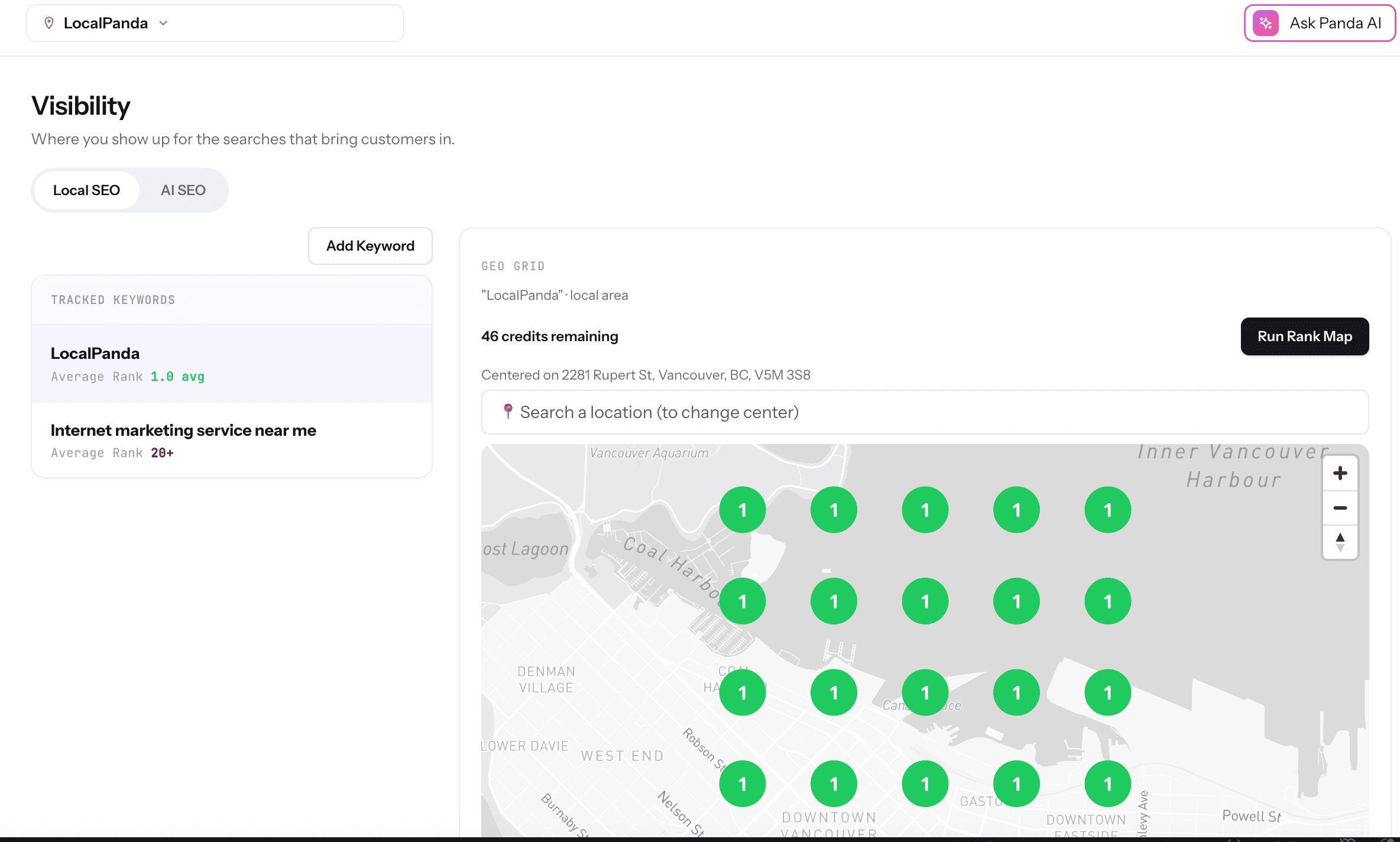
The agent tracks the exact searches a nearby customer types into Google before calling — not a single vague keyword, but the specific service and urgency terms buyers actually use.
| Search | Buyer intent |
|---|---|
| personal injury lawyer Seattle | high-value, considered |
| car accident lawyer Seattle | urgent to moderate, high-value |
| truck accident attorney Seattle | high-value, specific |
| wrongful death attorney Seattle | high-value, sensitive, considered |
| free consultation injury lawyer | lower-friction entry point |
Illustrative scenario: Harbor ranked in the top 5 for general "personal injury lawyer Seattle" searches for most of the year. Harbor Personal Injury Law dropped from position 6 to 12 for “truck accident attorney Seattle”, while a competitor referred to here as "Competitor A," a firm branding specifically around commercial trucking cases climbed to position 2.
The drop is specific to truck-accident searches, not general personal-injury searches, so the agent checks whether "truck accident" cases are listed as their own practice area on the GBP profile rather than folded into general "car accidents."
The agent notices Competitor A published a dedicated truck-accident page with case-type specifics (e.g., commercial insurance complexities) in the last quarter — a plausible contributing factor, though not confirmed causation.
The agent checks whether Harbor's recent reviews mention truck-accident cases specifically, since that practice area needs visible, compliant proof somewhere buyers and the algorithm can both see it.
Confirm "truck accident" is listed as its own named practice area on the GBP profile, not folded into general "car accidents."
Publish a dedicated truck-accident page explaining the added complexity of commercial-vehicle claims, matching the specificity Competitor A appears to be using.
With attorney sign-off, request reviews from past truck-accident clients that focus on the consultation and communication experience, not case outcomes.
02 · AI RECOMMENDATION VISIBILITY
AI Recommendation Visibility
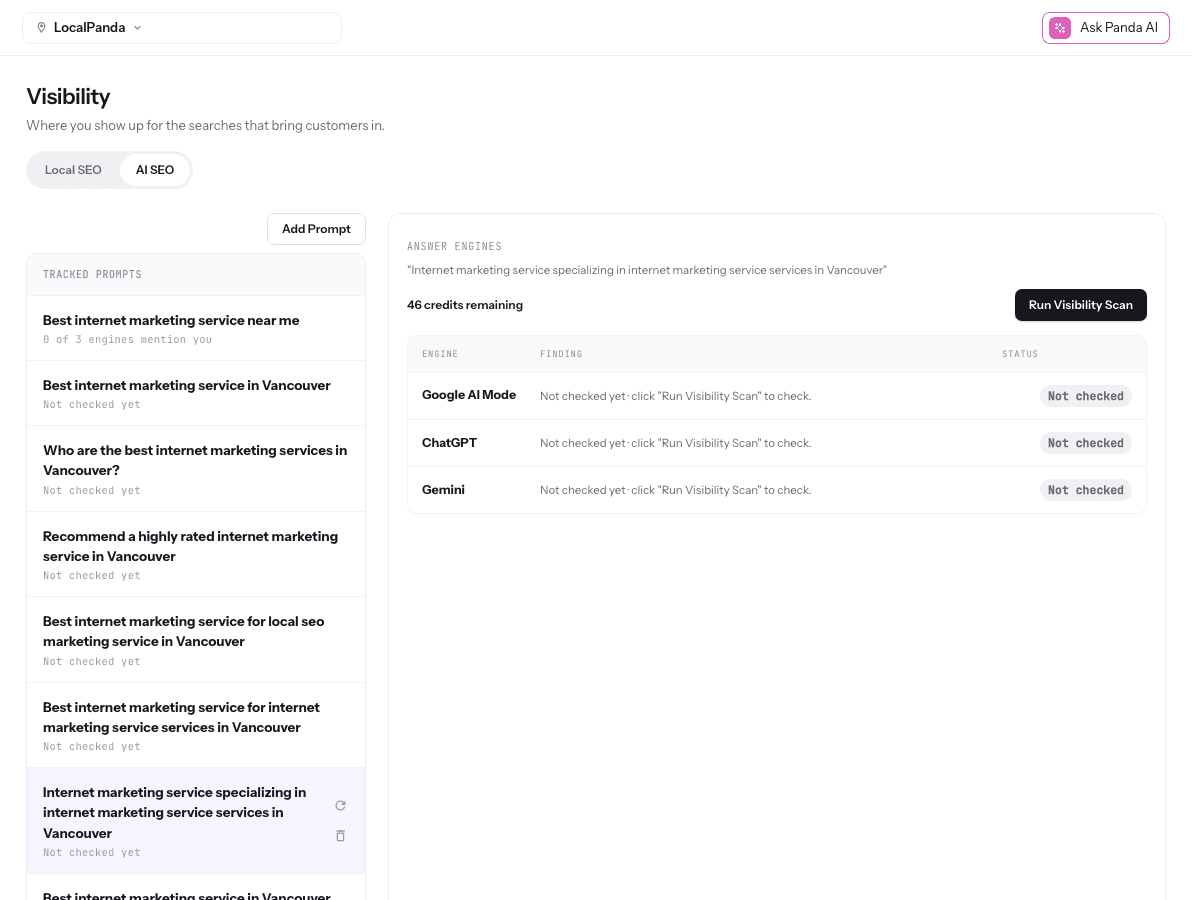
Buyers increasingly ask ChatGPT, Gemini, and Google AI Mode for a recommendation instead of scrolling search results. The agent tests the same questions a real customer would ask.
- “Which personal injury lawyers in Seattle offer a free consultation?”
- “Who handles truck accident cases in Seattle?”
- “Is [a specific law firm] a reputable personal injury firm in Seattle?”
Illustrative scenario — Prompt: “Which Seattle personal injury lawyers handle truck accident cases?”. Harbor Personal Injury Law does not appear in the answer. Instead, the assistant recommends Competitor A and Competitor B.
Competitor A is likely surfaced because of: a dedicated truck-accident practice-area page explaining commercial-insurance complexity; 80+ reviews mentioning clear communication throughout the case; a complete, verified Avvo profile with peer endorsements.
Competitor B is likely surfaced because of: a strong presence on Justia with detailed attorney bios; consistent educational content about the claims process.
Harbor Personal Injury Law is missing: any page or GBP description explicitly mentioning truck-accident case experience; reviews mentioning communication quality specifically; a complete Avvo or Justia profile.
Add explicit truck-accident case experience to the GBP description and a dedicated practice-area page.
With attorney approval, request reviews focused on communication and the consultation process rather than case specifics.
Claim and complete Avvo and Justia profiles with accurate attorney bios.
03 · REVIEWS AND REPUTATION
Reviews and Reputation
Review count and star rating are only the starting point. The agent looks at which specific topics show up in reviews — and which ones are missing.
| Reviews | Rating | |
|---|---|---|
| Harbor Personal Injury Law (illustrative) | 52 | 4.7 |
| Competitor A (illustrative) | 95 | 4.9 |
Review themes that matter most for this industry:
Harbor has very few reviews mentioning truck-accident cases specifically, despite handling them, while Competitor A has a visible cluster of reviews in that exact area.
Several reviews mention slow response times between updates — a communication theme worth addressing directly, not just in marketing but in client-service process.
With attorney sign-off, request reviews from past truck-accident clients focused on the consultation and communication experience.
Address the response-time theme directly in review replies, and consider it a client-service issue worth solving, not only a marketing one.
04 · GOOGLE BUSINESS PROFILE
Google Business Profile
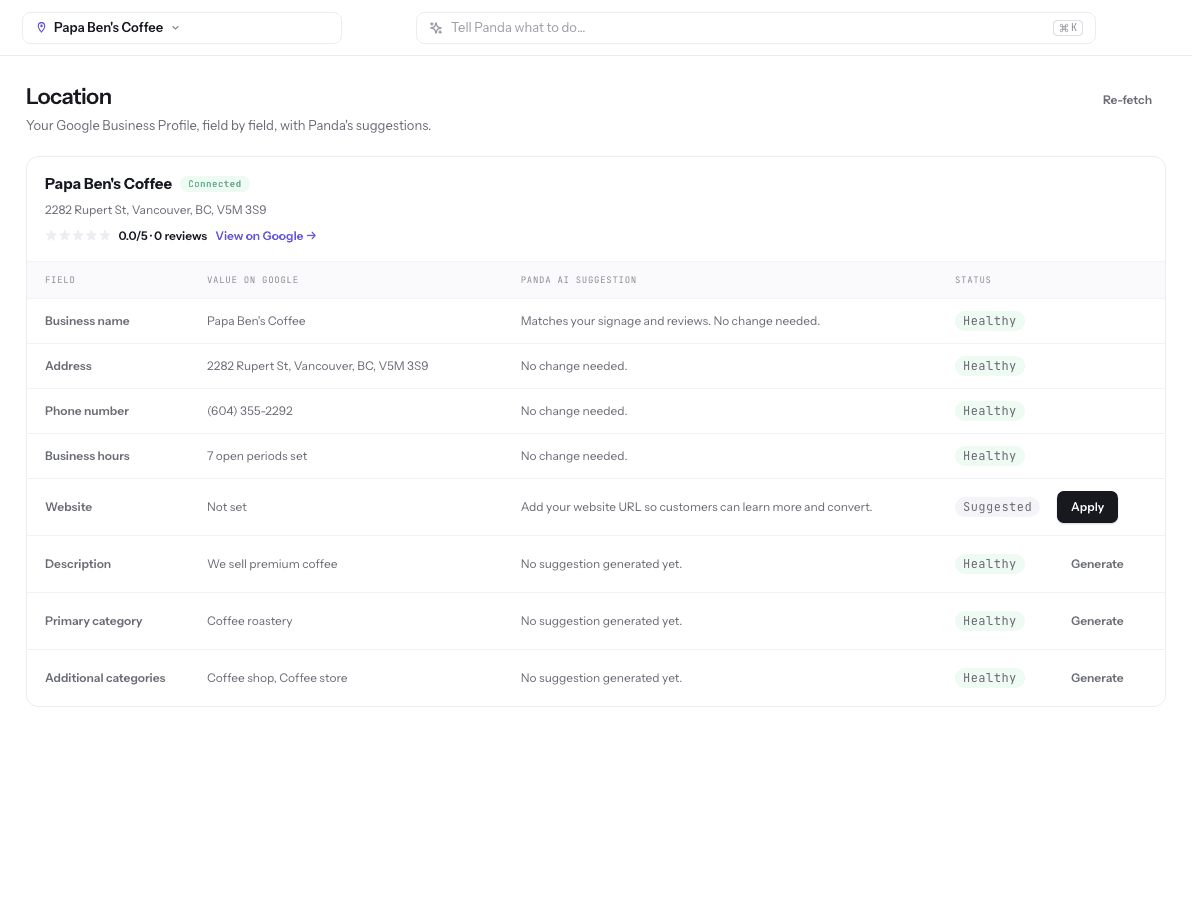
The agent inspects every element of the profile that affects trust and visibility, not just whether the listing exists.
Not sure if you have a case? Our free consultation walks through what happened, what your options are, and what (if anything) comes next — no pressure, no obligation.
Truck-accident cases are not listed as their own practice area, only implied under general "car accidents."
No GBP post in over a month.
05 · WEBSITE AND CONTENT GAPS
Website and Content Gaps
The agent compares Harbor Personal Injury Law’s site against a well-optimized illustrative competitor and flags pages that capture high-intent searches but don’t exist yet.
Illustrative competitor pages that already exist:
- /car-accident-lawyer-seattle/
- /truck-accident-lawyer-seattle/
- /wrongful-death-attorney-seattle/
Missing: /truck-accident-lawyer-seattle/
This is the exact keyword where the Maps-visibility scenario showed a competitor pulling ahead with a dedicated page explaining case-specific complexity Harbor doesn't currently have.
Suggested structure:
- Why truck-accident cases differ from standard car-accident claims (commercial insurance, multiple liable parties)
- What to expect during the consultation and claims process
- Attorney experience relevant to trucking cases, stated factually
Evidence to include:
- Bar-admission and relevant case-type experience, stated factually without outcome guarantees
- Reviews focused on communication and process, not results
Missing: /what-to-expect-at-a-consultation/
The AI-visibility scenario showed competitors winning on consultation-process clarity, which is also one of the lowest-risk, most compliance-safe pieces of content a firm can publish.
Suggested structure:
- What happens during the free consultation, step by step
- What documents or information to bring
- What happens after, if the firm takes the case
Evidence to include:
- A named intake contact
- Reviews mentioning the consultation experience specifically
07 · CONTENT CREATION
Content Creation, From One Idea
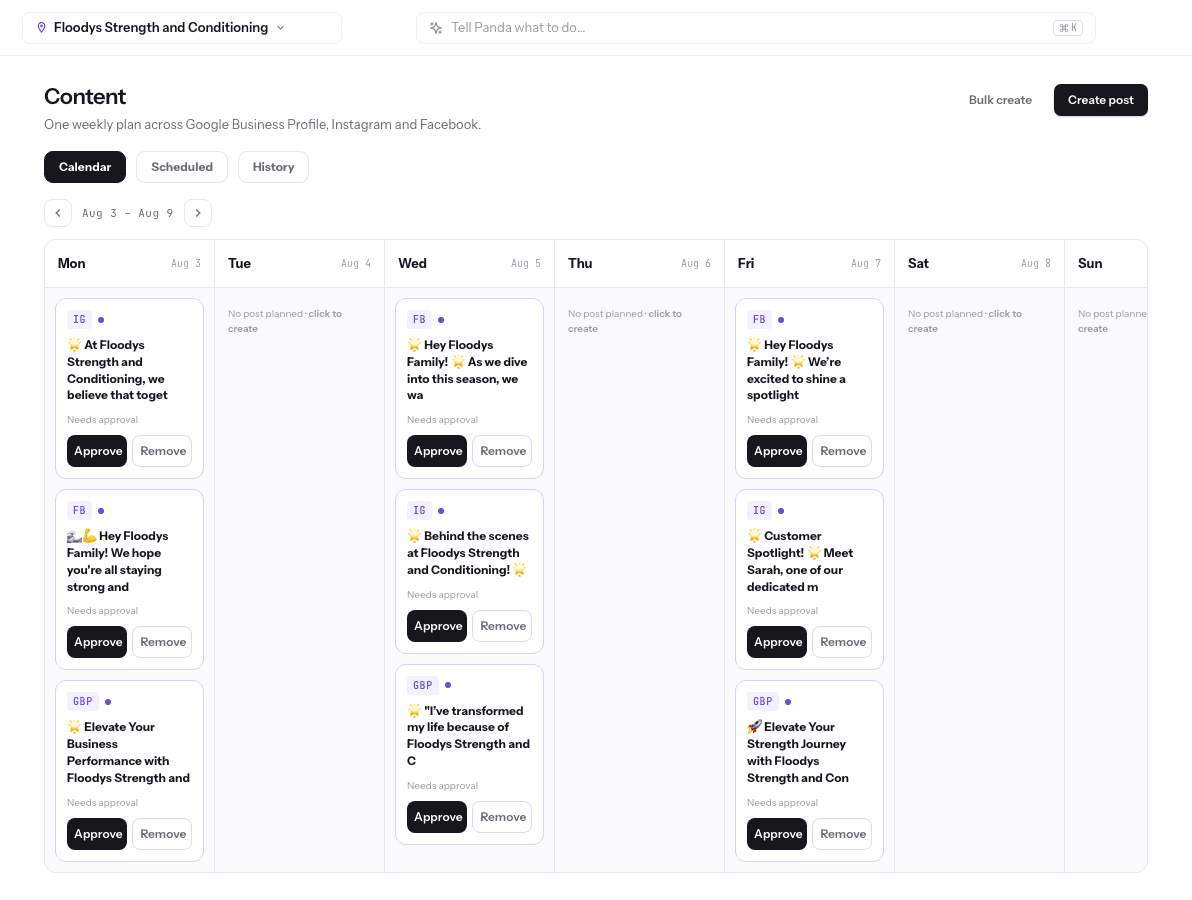
One idea — “What to expect at your first meeting with a personal injury lawyer” — becomes several pieces of content across every channel the agent manages.
Wondering what happens at your first meeting with us? Here's exactly what to expect — no legal jargon.
A short post walking through the consultation steps in plain language.
Carousel: "Step 1: tell us what happened. Step 2: we explain your options. Step 3: you decide, no pressure."
"What should I bring to my first consultation?" answered plainly, reviewed by an attorney.
A full article on the consultation process and what documentation is generally helpful, reviewed for accuracy and compliance.
A 30-second attorney-recorded clip explaining the consultation process, reviewed before publishing.
08 · SEASONALITY AND TRIGGERS
Seasonality and Trigger-Based Marketing
The agent watches for the specific events that change demand for this business, and reacts within the same day, not the same month.
Publish general, non-case-specific safety and know-your-rights content tied to the coverage, reviewed for accuracy and compliance before publishing.
Publish a plain-language explainer on what changed and what it means for injury claims, attorney-reviewed.
09 · COMPETITOR MONITORING
Competitor Monitoring
An illustrative example of what a weekly competitor report from the agent looks like:
> Competitor A published a refreshed truck-accident practice-area page.
> Competitor A gained 6 new reviews this week mentioning clear communication.
> Competitor B was recommended in an AI-assistant test prompt for "personal injury lawyer with a free consultation in Seattle."
> Harbor fell from position 6 to position 12 for "truck accident attorney Seattle."
Since the drop is isolated to truck-accident searches while general personal-injury rankings held steady, prioritize the truck-accident page and a compliant review push before broader content work — with attorney review at every step.
10 · OPERATING SYSTEM
What Your AI Marketing Agent Does Every Week
This is the cadence the agent runs every week — not a one-time audit.
Check Google Maps and AI search visibility by practice area.
A ranked list of practice-area keywords that moved more than two positions since last week.Review competitor activity, new reviews, and third-party mentions.
A short competitor log like the example above, with anything unusual flagged.Identify Google Business Profile and website gaps based on Monday and Tuesday's findings.
A prioritized list of profile fixes and missing pages, flagged for attorney review.Draft content and recommended actions for the week.
Draft GBP/social posts and, if warranted, a new page outline, queued for attorney sign-off before anything publishes.Measure what changed this week and set next week's priority.
A short recap: what moved, what published (after sign-off), what's next.11 · 30-DAY PLAN
A 30-Day AI Marketing Plan
An illustrative first month, from initial audit to a repeatable routine.
Understand visibility and the biggest gaps
- Run a full Maps and AI-visibility check by practice area
- Audit the GBP profile end to end
- Identify the 2-3 highest-intent missing website pages
Fix the highest-impact profile and content issues
- List each practice area explicitly and separately on GBP
- Publish the consultation-process page, attorney-reviewed
- Claim and complete the Avvo and Justia profiles
Build authority and publish content
- Publish 2-3 pieces of practice-area-specific content, attorney-reviewed
- Request reviews focused on communication and consultation experience
- Recheck AI-visibility prompts for evidence-gap progress
Measure changes and adapt
- Compare Maps rankings and AI-visibility results to week 1
- Review which changes correlated with movement
- Set priorities for the next 30 days
12 · CHECKLIST
Playbook Checklist
Bookmark this and run through it every week.
Google Maps Visibility
0/2AI Recommendation Visibility
0/2Reviews & Reputation
0/2Google Business Profile
0/2Website & Content
0/2Third-Party Mentions
0/1Competitors
0/2Reporting
0/1REVIEWS, THEMES TO WATCH
What reviews need to work for law firms
Themes the agent watches for in every new review:
- Never draft or publish a reply that confirms a client relationship or case detail without attorney sign-off.
- Consultation-process reviews (ease of scheduling, clarity of explanation) are strong, safe content to highlight.
- Track review sentiment by practice area separately — family law and personal injury reviews read very differently.
CONTENT THAT EARNS TRUST
More content ideas the agent can turn into posts
- What to expect at an initial consultation
- Which documents to bring for a given practice area
- Attorney-reviewed answers to common service questions
- Office accessibility and appointment scheduling details
FREQUENTLY ASKED QUESTIONS
Questions about the agent and this playbook
What does an AI marketing agent do for a law firm?
It continuously checks Google Maps rankings, monitors AI search visibility, audits your Google Business Profile, drafts review responses, publishes GBP and social content, and reports what changed every week — the recurring marketing work most law firms don't have time to do themselves.
Does it publish anything without approval?
You approve review replies and posts before they go out. The agent drafts the work and organizes it into a weekly routine; you stay in control of what publishes.
How is this different from local SEO for law firms?
Local SEO fundamentals (profile accuracy, citations, structure) still matter — see our law firms local SEO guide for that. This page covers the ongoing weekly operating work an agent performs on top of that foundation.
Why does this playbook emphasize attorney sign-off so heavily?
Legal marketing operates under bar-advertising rules that don't apply to most other local businesses. Every review response, post, or page recommendation here is meant to be drafted first and reviewed by an attorney before anything publishes.
Is the Harbor Personal Injury Law example based on a real firm?
No. Harbor Personal Injury Law is a fictional business used throughout this playbook to make the recommendations concrete. All figures, competitor names, and scenarios are illustrative.
Does a complete Avvo or Justia profile directly improve AI search rankings?
That's not a claim this playbook makes. These sources matter as places prospective clients and AI assistants can independently find corroborating information about a firm — discovery and trust signals, not confirmed ranking factors.
Can I run this playbook without LocalPanda?
Yes — everything here can be done manually. An AI marketing agent like LocalPanda is built to continuously monitor these signals and help draft and prioritize the work, with attorney review remaining the firm's responsibility either way.
Want the local SEO fundamentals too?
See the dedicated local SEO guide for law firms, covering profile setup, citations, and ranking basics.
Local SEO for Law Firms →Not sure where you stand?
Run the free Local Marketing Audit and get a score across Maps visibility, AI search, GBP health, reviews, content, and social.
Run the free audit →See what Panda would work on for a firm like Harbor Personal Injury Law
Start a free 3-day trial and let LocalPanda's AI marketing agent monitor these signals and help execute the work every week.